
Meta's Commerce Stack | Muse, Smart Glasses & Monetisation of AI Beyond Advertising
Connect 2026 turned Meta's wearables line into a checkout counter. The platform contest is no longer about who owns the operating system. It is about who owns the agent holding the wallet.
The smartphone era made Apple and Google toll collectors on digital commerce. Meta spent a decade paying that toll and has now built every piece needed to route around it: an agent people use, merchants that accept it, rails that settle it, and endpoints it owns, sold through the world's dominant eyewear house. The fee is small and the risks are real. But the strategic shift is clear. The next platform war will be decided less by whose model is smartest than by whose agent is standing at the till when the customer says yes.
#CapitalInsights, #Meta, #MuseAI, #AgenticCommerce, #SmartGlasses, #EssilorLuxottica, #AIStack, #DistributionReset, #LuxuryFinancialization, #PunjabCapitalResearch



The Late-Cycle Marker | SoftBank, OpenAI & What History's Largest Junk Deals Foretold
A record $11 billion below-investment-grade bond, raised to fund a private AI stake, read against a century of late-cycle credit records — and what the pattern says about where the AI cycle now stands.
That superlative — "largest junk deal ever" — is where most of the coverage begins and ends. It is also the least interesting fact about the transaction. Size records in high yield fall routinely as the asset class grows; the notional alone tells you almost nothing. What matters is the conjunction this deal puts in one instrument: a record notional, a below-investment-grade rating, and a use of proceeds that is neither a refinancing nor a capex programme against owned, cash-generating assets, but a follow-on equity stake in a private company that throws off no distributable cash. When those three converge, the deal stops being a financing event and becomes a tape-read.
#SoftBank, #OpenAI, #HighYield, #JunkBonds, #AICapex, #CreditCycle, #Numericable, #DataCenters, #PrivateCredit, #CapitalCycle, #MasayoshiSon, #Fibre2001

The Wealth Stack | How the Wealth Model Actually Earns | Four Revenue Layers & Which Ones AI Breaks
Four Revenue Layers | Advice, Lending, Access, Inertia & Which Ones AI Breaks
A wealth-management franchise is priced by the market as though it earns one kind of rev‐ enue — a fee on assets, sticky and compounding with the market. It does not. Beneath the single reported line sit four distinct engines: a fee on advice, a spread on lending, a toll on ac‐ cess, and a spread on inertia. Each carries a different exposure to the force now reordering the industry. Artificial intelligence does not compress the wealth model evenly — it dissolves friction, and only some of these engines are
#TheWealthStack, #DistributionReset, #NetInterestIncome, #SweepCash, #DirectIndexing, #TaxAlpha, #PledgedAssetLines, #PrivateMarkets, #iCapital, #CAIS, #Custody, #Schwab, #Altruist, #AIStack, #DataAndDistribution, #PunjabCapitalResearch, #FundamentalsThroughTheNoise

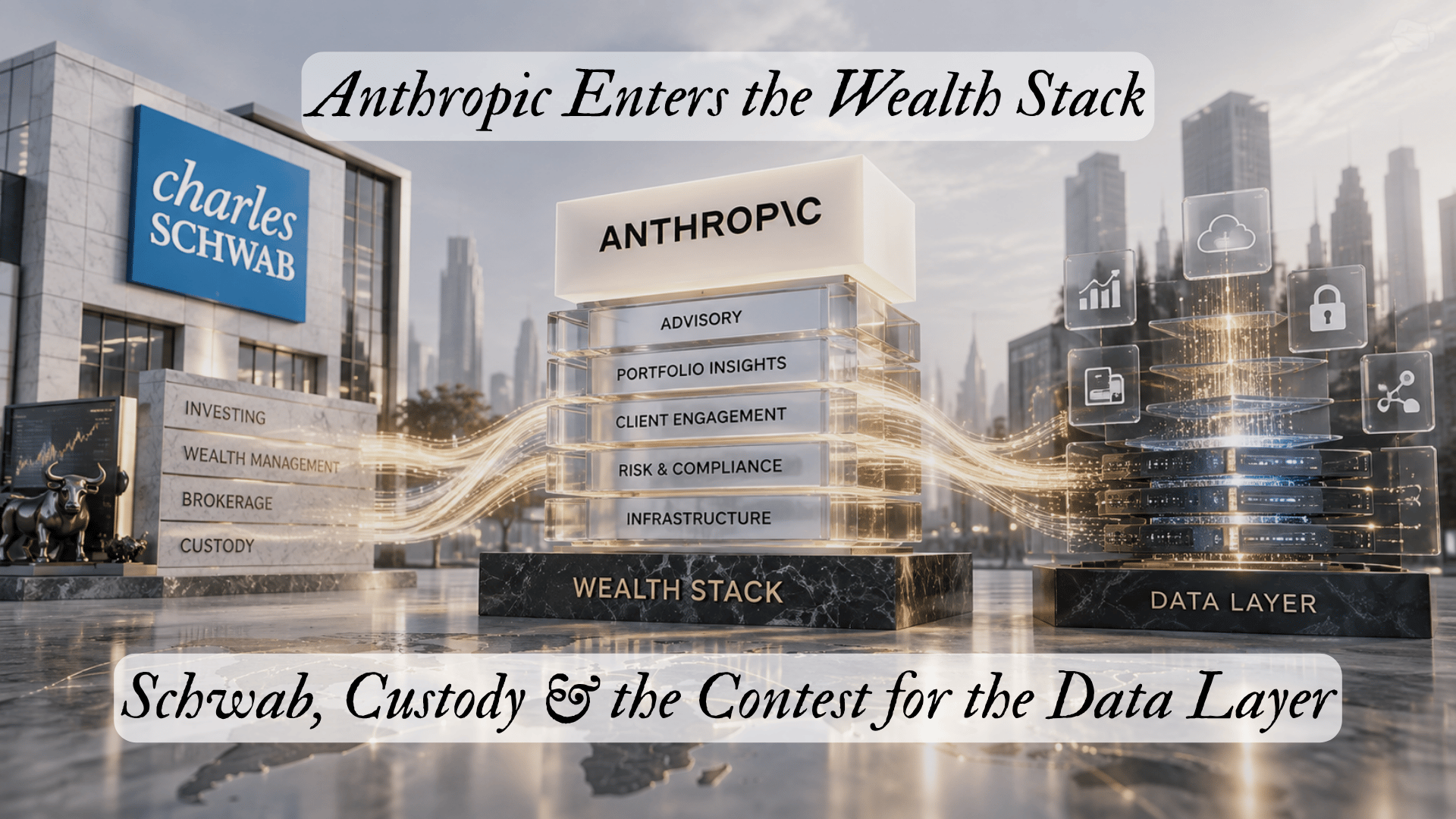


Anthropic Enters the Wealth Stack | Schwab, Custody, and the Contest for the Data Layer
Read past the product framing and the Schwab–Anthropic tie-up is not an AI launch; it is a bid to occupy the data-and-distribution layer of the wealth stack. The model itself is incidental. What is being contested is proximity to the advisor’s book and to custodial data — the layer where value accrues once raw capability commoditizes. The party carry‐ ing the most strategic risk in the deal is not the one that built the model. It is the custodi‐ an that opened the door.
#WealthStack, #AIStackCapitalMap, #DistributionReset, #Custody, #RIA, #Anthropic, #Schwab, #AdviceLayer, #DataLayer, #Fintech