
The Clearing Price | GIC’s US$2 Billion Sale & the Bid Beneath Private Credit’s Marks
GIC is finalising the sale of up to US$2bn of private credit fund stakes through Evercore. The private credit secondaries market nearly doubled to ~US$20bn in 2025 from US$10.9bn in 2024. It is becoming the release valve an asset class built on hold-to-maturity insisted it would never need. Healthy books change hands near 92% of NAV; stressed paper is bid at 20–35% discounts. The dispersion is the information.
#PrivateCredit, #Secondaries, #GIC, #SovereignWealth, #PriceDiscovery, #NAV, #BDC, #BlueOwl, #SabaCapital, #ContinuationVehicles, #DirectLending, #Evercore, #CreditCycle, #MarkToMarket, #Liquidity, #Allocators, #PunjabCapitalResearch, #CapitalInsights, #FundamentalsThroughTheNoise

The Address & the Price | Gold’s Custody Migration, & its Decoupling from Spot
Gold’s price answers to the Strait of Hormuz on an hourly clock. Its address answers to something slower and far harder to reverse. The World Gold Council’s 2026 reserve survey — fielded straight through the worst of a 22% drawdown — shows central banks re- architecting where their bullion physically sits. That custody migration is running independently of the price screen, and most of this week’s coverage has filed it under the wrong story.
Custody location has become a third axis of reserve management — distinct from price, distinct from composition, and, as this week made plain, distinct from the price cycle entirely. The metal’s value is negotiating with the Strait of Hormuz; its address is negotiating with the architecture of the multipolar order.
#Gold, #CentralBanks, #ReserveManagement, #GoldCustody, #WorldGoldCouncil, #Singapore, #MAS, #Repatriation, #ReserveFragmentation, #Multipolarity, #BankOfEngland, #NewYorkFed, #PunjabCapital, #CapitalInsights
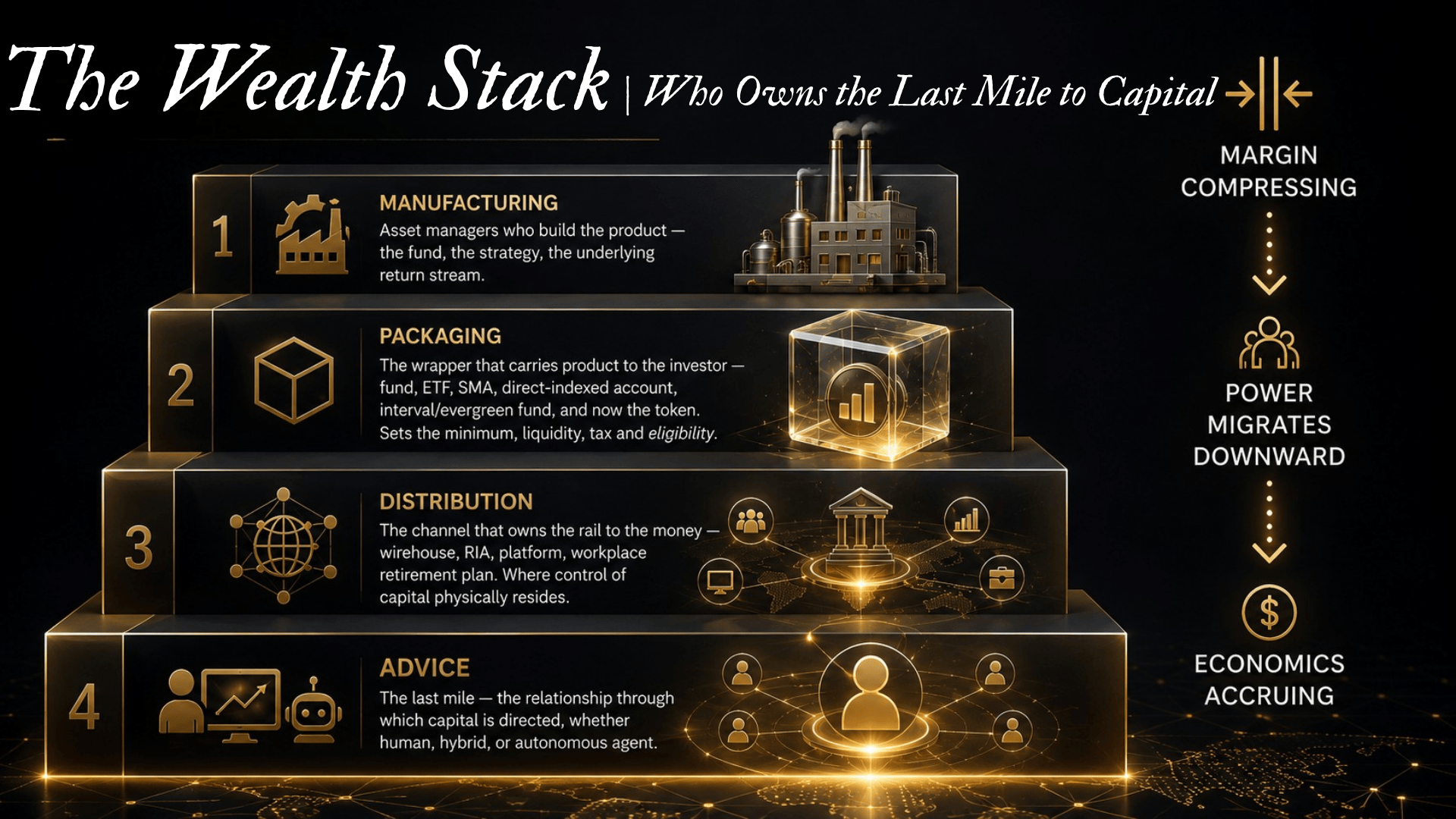
The Wealth Stack | Who Owns the Last Mile to Capital
A framework for reading the restructuring of global wealth management — and the migration of economic power down the stack, from the firms that manufacture product toward the channels and relationships that control the investor's money. This note is the anchor for an ongoing Capital Insights series; the modules that follow are close reads of each layer as it goes live.
#WealthManagement, #DistributionReset, #WealthStack, #PrivateMarkets, #RIA, #401k, #AlternativeInvestments, #DirectIndexing, #Tokenisation, #FeeCompression, #GreatWealthTransfer, #AgenticAI, #AssetManagement, #CapitalInsights, #PunjabCapitalResearch, #FundamentalsThroughTheNoise, #FamilyOffices, #SovereignWealth, #Allocators, #WealthTech




Pooling the Float - The Yen Stablecoin
Japan’s three megabanks aren’t launching a coin — they’re building a shared issuance rail under a trust. It is the first serious non-US answer to who gets to mint a currency’s digital form, and who keeps the float that comes with it: the structural mirror image of the deposit-defence dynamic.
#Stablecoins, #TokenizedMoney, #Japan, #MUFG, #Progmat, #PaymentRails, #FloatEconomics, #DigitalAssets, #DistributionReset, #CapitalMarkets

AI Financing | Wrapping the Depreciation
A $35bn vendor-wrapped SPV imports the data-center financing playbook onto depreciating silicon. The price stack says no one underwrites TPU residuals on their own — and the depreciation risk has been routed, not removed.
Each new deal in the channel adds vendor-balance-sheet concentration to a risk — silicon depreciation — that the structure has been built specifically not to price. The wrapper has not removed the depreciation. It has wrapped it, tranched it, and shipped it down the capital structure and out into the insurance system. Knowing where it landed is the whole of the trade.
#PrivateCredit, #AIInfrastructure, #Anthropic, #Broadcom, #ChipFinancing, #ABS, #StructuredCredit, #SPV, #ResidualValue, #InsuranceCapital, #Apollo, #Blackstone, #AtlasSP, #VendorFinancing, #CapitalInsights, #PunjabCapital

Tokenisation, Private Markets & The Authorized Wrapper
Citi, the pre-IPO access war, and the distance between custody and consent On 11 June 2026, Citigroup launched Digital Depositary Receipts, a structure that wraps shares of late-stage private companies in a bank-issued, blockchain-recorded security and settles them on SIX’s regulated SDX platform. The inaugural instrument referenced Kaleido, a Citi-backed tokenisation firm. The pitch is explicit — a single, trusted issuer-custodian as a cleaner alternative to the special-purpose vehicles that have proliferated around the hottest private names The throughline is the one we have pulled all spring — as private assets are wrapped for wider distribution, value accrues to whoever controls the authorised point of access. Authorisation, not tokenisation, is the scarce input.
#Tokenisation, #Citi, #PreIPO, #PrivateMarkets, #DepositaryReceipts, #Anthropic, #SpaceX, #SPV, #DigitalAssets, #SDX, #Blockchain, #DistributionReset, #CapitalMarkets, #PCR

Indonesia’s Independence Discount
Jakarta’s selloff reads as a currency story. It is better understood as a re-rating of institutional credibility — and which of the two it is determines whether the move is a mispricing to fade or a correct fear to respect.
The independence discount is repairable, but it is not self-correcting. It narrows only when the institutional signal clarifies — a fiscal anchor markets trust, a central bank visibly free to prioritise stability, and a state-capitalism agenda specified rather than improvised. None of that is precluded; Indonesia rebuilt exactly this trust once before, and the arc from 1998 to investment grade is evidence it can be done. But it is earned on signal, not asserted on conviction. Until the institutions read clearly again, the discount holds. Watch the institutions, not the rupiah.
#CapitalInsights #Indonesia #Rupiah #BankIndonesia #CentralBankIndependence #CostOfCapital #EmergingMarkets #SovereignCredit #Danantara #Prabowo #BurdenSharing #FiscalCredibility #AssetAllocation #IDX #PunjabCapitalResearch #FundamentalsThroughTheNoise

Citi Takes the Tokenization Wrapper to Pre-IPO Private Equity
Up the Asset Stack Citi takes the tokenization wrapper to pre-IPO private equity On 11 June 2026, Citigroup launched Digital Depositary Receipts a structure that wraps shares of late-stage private companies in a bank-issued, blockchain-recorded security and settles them on SIX’s regulated SDX platform, built on R3’s Corda permissioned ledger. Citi issues the receipts and acts as custodian. Distribution at launch runs through Sygnum in Switzerland and SBI Digital Markets in Singapore; access is restricted to non-US (Reg S) investors, with US availability promised once conditions allow. The inaugural instrument referenced Kaleido, a Citi-backed tokenisation firm. The pitch is explicit — a single, trusted issuer-custodian as a cleaner alternative to the special-purpose vehicles that have proliferated around the hottest private names
#Tokenisation, #Citi, #PrivateMarkets, #PreIPO, #DigitalAssets, #DepositaryReceipts, #Blockchain, #SDX, #CapitalMarkets, #TradFi, #PCR

A Neutral Read on Tokenisation | Tokenisation has stopped being a slogan & become a market - Here is the scorecard, & an even-handed read
Real, partial, and unfinished. For PCR's purposes the practical posture follows directly: use the parts that work, underwrite the parts that are still claims rather than facts, and watch fragmentation and legal certainty as the variables that decide which future arrives. The prophecy was early. The scorecard says it is also, so far, only partly right.
#Tokenisation, #RWA, #RealWorldAssets, #DigitalAssets, #Blockchain, #LarryFink, #BlackRock, #BUIDL, #TokenizedTreasuries, #Stablecoins, #PrivateCredit, #TokenizedEquities, #Gold, #IMF, #FinancialStability, #DeFi, #CapitalMarkets, #Securitize, #Ondo, #FundamentalsThroughTheNoise, #PunjabCapitalResearch, #CapitalInsights

The Retail Threshold | Tokenisation’s Arrival Signal |DBS Launches Tokenised Physical Gold to Retail
The Retail Threshold | Tokenisation’s Arrival Signal | DBS Bringing Tokenised Physical Gold to Retail Customers
DBS is bringing tokenised physical gold to retail customers in Singapore. The asset is not the story — the buyer is. Tokenisation has crossed its hardest threshold, at a systemically important bank, on regulated rails.
On 11 June, DBS said it will offer a tokenised physical gold product to retail customers through its digibank app in the second half of 2026. Read as a headline, it is one more entry in a long file of tokenised-gold launches. Read carefully, it is a different category of event.
#Tokenisation, #Tokenization, #RWA, #RealWorldAssets, #DBS, #DigitalGold, #TokenisedGold, #PhysicalGold, #Singapore, #MAS, #ProjectGuardian, #SBMA, #GoldTradingHub, #OCBC, #UOB, #DBSDigitalExchange, #Blockchain, #DigitalAssets, #WealthManagement, #PrivateMarkets, #MoneyMarketFunds, #FranklinTempleton, #Fintech, #CapitalMarkets, #AssetTokenisation, #RetailInvesting, #FractionalOwnership, #NeutralHub, #PunjabCapitalResearch, #CapitalInsights, #FundamentalsThroughTheNoise

The Rated Exit | Turning ageing buyout-fund stakes into bonds for insurers
The Rated Exit | Blackstone, Carlyle,& Coller are turning ageing buyout-fund stakes into bonds for insurers.
Blackstone is marketing more than $2bn of limited-partner stakes in other managers' leveraged buyout funds as a collateralised fund obligation — a rated, tranched bond sold to insurers. The headline reads as a large deal in a frozen market. The number that matters is buried at the bottom of the page: the equity tranche is taking longer to place. That is the whole story.
#PrivateEquity, #Secondaries, #CFO, #CollateralisedFundObligation, #Blackstone, #Carlyle, #CollerCapital, #StrategicPartners, #InsuranceCapital, #MatchingAdjustment, #SolvencyII, #PrivateCredit, #Securitisation, #DPI, #ContinuationFunds, #NAVLoans, #LiquidityEngineering, #AllocatorStrategy, #PunjabCapitalResearch, #CapitalInsights

How Technology Valuations Stopped Being Discovered & Started Being Declared
Three of the most valuable companies on earth — SpaceX, OpenAI and Anthropic — together carry valuations approaching three and a half trillion dollars, and not one of them has a public share outstanding. All three moved toward a listing inside a single quarter. Read against revenue, their multiples invert ordinary intuition: the business with hard assets and the largest top line is the most expensive on sales, while the company that has just claimed the global crown is, on the same measure, the cheapest of the three.
When the most coveted assets are priced privately and set by declaration rather than cleared by a market, access overtakes entry multiple as the binding constraint — and what is underwritten is a position in a narrative that a small, reflexive pool of capital is co-authoring, not a claim on near-term cash flow.
#TechValuation, #PriceDiscovery, #PrivateMarkets, #SpaceX, #OpenAI, #Anthropic, #AIcapital, #IPO, #SovereignWealth, #FamilyOffice, #CapitalFormation, #FounderDiscount, #PunjabCapitalResearch, #CapitalInsights

What DeepSeek’s First Raise Means for Cheap AI
A lab that built its reputation on refusing outside money is taking it — and the same week, its prices are collapsing across China’s AI market. The two facts are one story. The question for allocators is not who is subsidising cheap tokens, but what every major AI ecosystem’s capital structure now tells you about the price.
#CheapAI, #OpenWeights, #InferenceEconomics, #AICapitalStack, #ChinaTech, #Tencent, #CATL, #SovereignAI, #ExportControls, #CircularFinancing, #PrivateValuations, #AllocatorWatch, #FundamentalsThroughTheNoise, #PunjabCapitalResearch

Defending the Float | Why Banks Choose Tokenized Deposits over Stablecoins
The shared tokenized-deposit network is read as banks embracing crypto rails. It is the opposite: an incumbent defense of money creation. The instrument choice and the consortium structure both confess what is actually being protected — the deposit as a fundable, lendable liability.
#TokenizedDeposits, #Stablecoins, #GENIUSAct, #BankingSystem, #DepositFlight, #TheClearingHouse, #NetInterestMargin, #MoneyCreation, #DigitalAssets, #MonetaryPlumbing, #CapitalMarkets, #DollarPrimacy, #PunjabCapitalResearch, #CapitalInsights
Meta's Equity Raise | The Crowded Window for AI’s Equity-Supply Convergence
In our recent video, in The Equity Tell, we argued that the form of Alphabet’s record raise mattered more than its size.
What has happened since suggests the posture was not idiosyncratic. It is becoming a cohort. That offering closed larger than it opened: the first tranche was lifted on demand, a second is scheduled for the coming quarter, and the total now stands as the largest equity sale on record in any industry. Within days, reports surfaced that Meta is weighing a raise of its own in the tens of billions, and analysts began naming the remaining hyperscalers as candidates to follow. The question this note takes up is not whether the AI build-out will be funded. It will. The question is what happens to the price of capital when every large issuer reaches for the same pool at the same moment — and who, on the other side, is left holding the supply.
#CapitalInsights, #PunjabCapitalResearch, #FundamentalsThroughTheNoise, #AICapex, #EquitySupply, #Hyperscalers, #Meta, #Alphabet, #AIInfrastructure, #CapitalAllocation, #AbsorptionRisk, #IPOPipeline, #CostOfCapital, #SovereignWealth, #MarginalBuyer

India's Central Bank Makes Its First Move | Part 2
Why the Rupee Keeps Falling | India's Central Bank Makes Its First Move | Part 2
Last week the central bank chose to do nothing dramatic. This week the government changed the rules instead — to pull foreign money in, rather than spend its savings defending the currency. A few days ago we looked at why India's currency, the rupee, keeps sliding — and at the central bank's surprising response: it did nothing dramatic. It left interest rates unchanged and defended the currency mostly with reassuring words. The real signal to watch, we said, was whether the authorities would shift from talking to actually spending. This week they did something — but not quite either of the moves we were watching for.
#India, #Rupee, #IndianEconomy, #RBI, #Bonds, #ForeignInvestment, #Tax, #Currency, #ForexReserves, #GDP, #Markets, #Explained, #MarketsExplained, #CapitalInsights

Bitcoin’s Structural Problem in a Fragmenting Monetary Order
Bitcoin | The Reserve That Sells Itself Bitcoin’s Structural Problem in a Fragmenting Monetary Order
This week’s Bitcoin drawdown — roughly eighteen percent, into the low $60,000s — will be read by most desks as a sentiment story: exchange-traded fund outflows, a liquidation cascade, capital rotating into the artificial-intelligence equity complex. That reading is not wrong, but it is shallow. The more durable signal sits one layer down, in the structures through which institutions actually hold Bitcoin. A single disclosure — Strategy selling thirty-two coins to meet a preferred-stock coupon — matters not for its size but for what it exposes about whether Bitcoin can occupy the role its proponents claim for it: a neutral reserve asset for a fragmenting monetary order. Our view is that it cannot, and that the reason is structural rather than directional.
#Bitcoin, #ReserveFragmentation, #DigitalGold, #DAT, #Strategy, #mNAV, #StrategicBitcoinReserve, #Gold, #MultipolarOrder, #ReserveAssets, #CapitalAllocation, #PunjabCapitalResearch, #CapitalInsights, #FundamentalsThroughTheNoise

The Case for Owning Your AI | & Token Economics of bringing AI In-house
The signal is that AI infrastructure spend is beginning to fragment rather than pool. The consensus trade has treated inference as a tide lifting a handful of hyperscaler balance sheets. The repatriation thesis implies that a portion of that spend redirects toward server original-equipment manufacturers, edge-hardware vendors, and the colocation operators who would house on-premise factories that do not fit inside corporate walls.
None of this displaces the hyperscalers at the frontier, where training and the most capable models remain centralised. But it complicates the cleaner version of the hyperscaler-margin story, in which every incremental AI dollar accrues to the same few providers. The more interesting exposures may be the picks-and-shovels names positioned across both deployment modes, and the operators whose economics improve whether inference centralises or disperses. The standing caution is that this remains, for now, a vendor-led narrative; the buy-side evidence of repatriation at scale is still largely anecdotal.
#AIInfrastructure, #InferenceEconomics, #TokenFactory, #DataSovereignty, #CapitalAllocation, #EdgeAI, #Hyperscalers, #EnterpriseAI, #JevonsParadox, #PunjabCapital, #CapitalInsights

Why the Rupee Keeps Falling — & What India's Central Bank Said by Doing Nothing
India's currency is under pressure from two very different directions at once.
Last week the central bank made a quiet choice about how to handle it. One number, two problems India's currency, the rupee, has lost about 6% of its value against the US dollar this year — meaning it now takes noticeably more rupees to buy a single dollar. It's tempting to look for one cause.
The more accurate picture is that two completely separate problems are landing on the same number at the same time. One is slow and built into the system. The other is fast and tied to the headlines. The rupee is simply where they add up. '
Underneath all of it is a quieter point. The high prices foreign companies are cashing out at, the calm the central bank is projecting, the comfortable headline reserve figure — each one rests on a story of confidence. Stories like that tend to hold right up until the plain arithmetic underneath forces everyone to look. The rupee is just where the looking starts.
#India, #Rupee, #IndianEconomy, #RBI, #Currency, #ForexReserves, #Gold, #OilPrices, #Inflation, #StockMarket, #IPO, #ForeignInvestment, #Explained, #MarketsExplained, #CapitalInsights

Why Berkshire Hathaway & Japan's Homebuilders are buying into U.S. housing
Modular accounts for roughly 15% of Japanese housing against about 3% in the U.S.; these firms run factory-build at scale at home and are importing both the competence and the capital that the fragmented U.S. industry cannot generate on its own. In late May, Berkshire Hathaway agreed to acquire Taylor Morrison for about $6.8bn in equity value (≈$8.5bn enterprise) — its first multibillion-dollar acquisition under Greg Abel, struck at a trough multiple of roughly ten times earnings against a market near twenty-one, with mortgage rates at their highest since the prior August and builders discounting heavily to clear inventory. Berkshire already owns Clayton Homes, among the country's largest producers of manufactured and modular housing, and has signalled an intent — itself a departure from its hands-off tradition — to unify its site-built operations into a single platform. In parallel, Japan's largest homebuilders have been accumulating American share.
#USHousing, #Homebuilders, #ModularConstruction, #Industrialization, #BerkshireHathaway, #TaylorMorrison, #SumitomoForestry, #DaiwaHouse, #TriPointe, #ClaytonHomes, #PatientCapital, #ProductivityGap, #BuildingProducts, #Panelization, #CapitalAllocation, #CapitalInsights, #PunjabCapitalResearch