Why Central Banks Are Dumping Gold & The Real Pressure Points of West Asia Crisis
For years, the story in gold was simple: central banks buy, prices rise, and the metal's status as the ultimate reserve asset only grows stronger. That story is over. In the span of four weeks, gold just posted its worst monthly decline in eighteen years. Not because retail investors panicked. Not because inflation expectations collapsed. Because the central banks that spent a decade accumulating bullion are now liquidating it — fast. And at the center of this reversal is Turkey — which has sold or loaned out twenty billion dollars' worth of gold since the conflict began. This isn't a story about one country's currency crisis. It's a story about what happens when the assumptions underpinning a decade-long rally suddenly flip — and what that reveals about the true hierarchy of central bank priorities when real pressure arrives.
#Gold, #CentralBanks, #Turkey, #Lira, #GoldPrice, #Reserves, #MacroAnalysis, #CapitalInsights
The AI Services Value Chain | From Foundation Models to Portfolio Exits
A structural shift is underway in how artificial intelligence reaches the enterprise. Foundation model developers are moving beyond API-based revenue models toward direct involvement in implementation, creating a new services layer that private equity firms are now co-investing to accelerate. This convergence reflects a mutual recognition: AI labs need distribution beyond self-service adoption, and PE sponsors need working AI implementations to justify multiples on portfolio exits. The emerging value chain—from model providers through consulting joint ventures to PE-owned operating companies—represents a distinct capital formation pattern that may define AI's commercial maturation over the next three to five years. For institutional allocators, understanding where value accrues across this chain is increasingly relevant to both direct AI investments and broader exposure through PE commitments.
#AIServices, #PrivateEquity, #EnterpriseAI, #Anthropic, #OpenAI, #CapitalMarkets, #VentureCapital, #AIImplementation, #TechInvesting, #CapitalInsights #PunjabCapital, #PunjabCapitalCapitalInsights

The Tokenization of Traditional Assets | Capital Insights
Tokenized equities represent one of the most significant structural shifts emerging in global capital markets. These digital tokens, which provide price exposure to traditional stocks via blockchain infrastructure, enable round-the-clock trading and near-instantaneous settlement. While currently prohibited for US retail investors, major institutional players including DTCC and Nasdaq are building the infrastructure for domestic adoption. The current global market stands at approximately $900 million with 200,000 holders, but the trajectory points toward comprehensive tokenization of traditional assets. DTCC has articulated an ambition to eventually tokenize the full $100 trillion in assets under its custody. For investors and allocators, understanding this infrastructure evolution is essential to anticipating how market access, settlement mechanics, and capital efficiency may transform over the coming years.
#Tokenization, #DigitalAssets, #CapitalMarkets, #BlockchainFinance, #DTCC, #Nasdaq, #CryptoEquities, #FinancialInfrastructure, #SettlementInnovation, #MarketStructure, #PunjabCapitalCapitalInsights, #PunjabCapital

The AI Trade | Earnings Catch-Up or Multiple Compression Ahead?
"Fundamentals Through the Noise"
"Fundamentals Through the Noise" The AI infrastructure buildout has entered an unprecedented phase, with the five largest hyperscalers committing between $650-700 billion in capital expenditures for 2026 alone—a 36% increase from already record 2025 levels. Yet as capex accelerates, a critical valuation recalibration is underway. The Magnificent Seven cohort has underperformed the broader market year-to-date, with all seven stocks in negative territory through mid-March 2026. The central question for allocators: are current multiples pricing in realistic monetization timelines, or does the gap between infrastructure investment and revenue generation signal compression ahead?
Bottom Line: The AI trade is transitioning from a momentum-driven phase to a fundamentals-driven phase. Multiple compression has already absorbed some of the speculative excess, but the gap between infrastructure investment and demonstrable monetization remains the central risk. Selective positioning in names with clearest earnings visibility (NVIDIA, Meta, Alphabet) appears more attractive than broad Mag 7 exposure. The earnings growth convergence with the S&P; 493 suggests maintaining diversification rather than concentrated AI bets.
#AIValuations, #MagnificentSeven, #TechStocks, #HyperscalerCapEx, #EarningsGrowth, #MarketValuation, #NVIDIA,#Microsoft, #InvestmentStrategy, #CapitalInsights, #PunjabCapital, #PunjabCapital-CapitalInsights
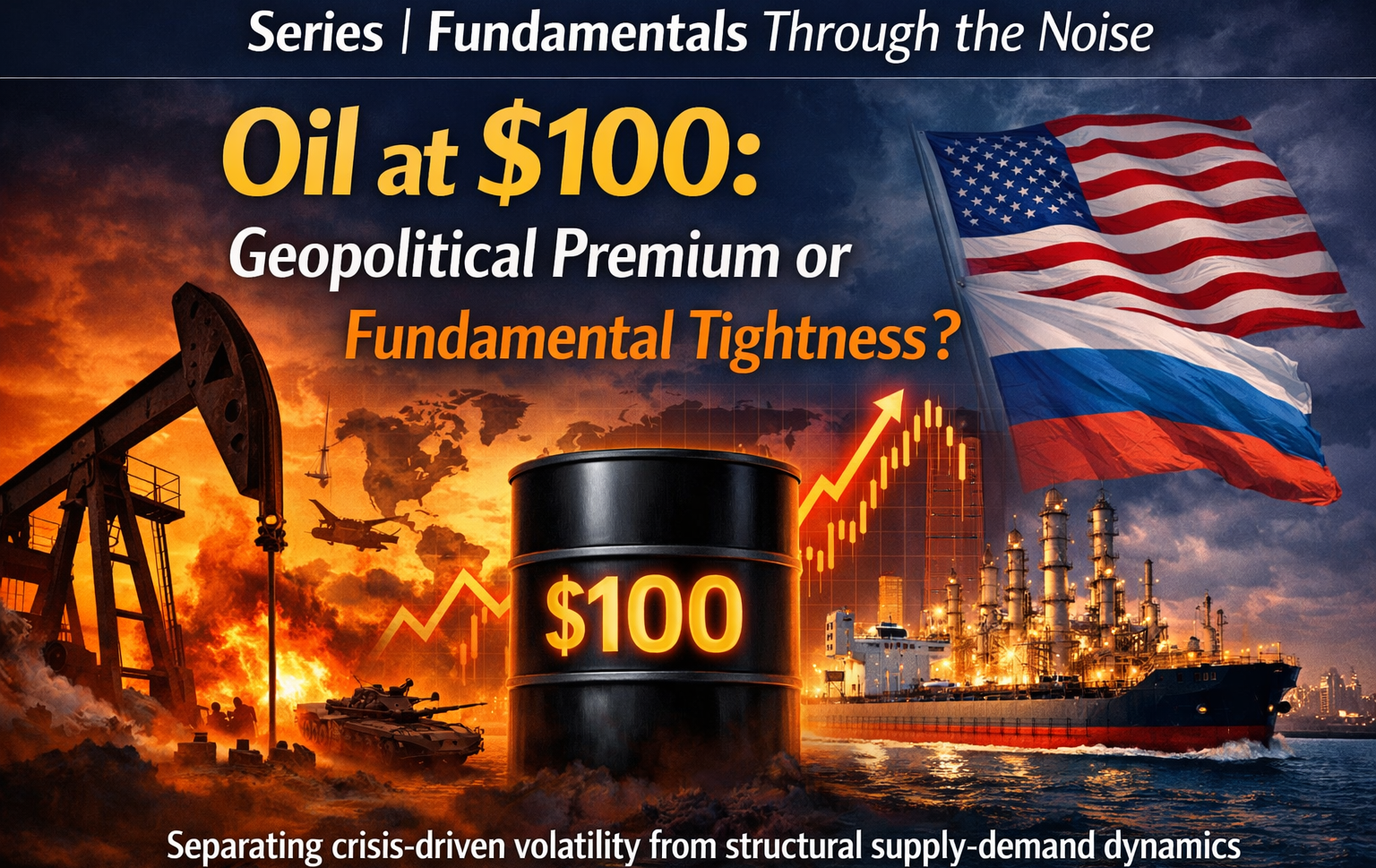
Oil at $100 | Geopolitical Premium or Fundamental Tightness?
Separating crisis-driven volatility from structural supply-demand dynamics.
Brent crude has swung between $90 and $115 over the past three weeks as the largest supply disruption in oil market history collides with coordinated policy response. The Strait of Hormuz crisis has removed roughly 10 million barrels per day of Gulf production capacity from effective global supply, triggering the IEA's largest-ever emergency reserve release of 400 million barrels. Yet beneath the geopolitical noise, pre-crisis fundamentals pointed to a well-supplied market with inventories above five-year averages and demand growth decelerating toward 0.8 mb/d annually. The core investment question: how much of the current price level reflects durable supply destruction versus transitory risk premium? Our framework suggests $25-30/bbl of the current price is crisis premium, with fair value converging toward $70/bbl once Hormuz flows normalize—but tail risks of prolonged closure warrant defensive positioning.
#OilMarkets, #StraitOfHormuz, #EnergyGeopolitics, #OPEC, #IEA, #CrudeOil, #MarketFundamentals, #RiskPremium, #AssetAllocation

Agentic Infrastructure as an Emerging Asset Class
AI Industry M&A Dynamics and Big Tech's Race for Multi-Agent Capabilities.
Global AI-related M&A; reached $4.9 trillion in 2025, a record year driven by infrastructure deals, talent acquisition, and the race to build agentic AI capabilities. Meta's acquisition of Moltbook—a social network for AI agents—signals that multi-agent interaction environments are now strategic assets, not novelties. This report examines the emerging asset class of agentic infrastructure, maps Big Tech's divergent acquisition strategies, and identifies implications for institutional investors navigating the AI M&A; landscape.
#AgenticAI, #AIMergers, #MetaAI, #VentureCapital, #AIInfrastructure, #BigTech, #CapitalMarkets, #MSL, #TalentWars, #PunjabCapitalResearch
The Paradox of Emergency Reserves | Why the IEA's Historic Release Is Lifting Oil Prices
Market dynamics during the Strait of Hormuz crisis reveal how intervention scale signals severity
The International Energy Agency announced its largest-ever coordinated release of emergency oil stockpiles—400 million barrels across member nations. Counter to conventional market logic, crude prices rose nearly 5% following the announcement, with Brent settling at $91.98 and WTI at $87.25, before Brent again crossed $100 in overnight trading. The market response reflects trader assessment that the intervention, while unprecedented in scale, remains insufficient to offset estimated losses of 12-15 million barrels per day from the effective closure of the Strait of Hormuz, coupled with growing storage constraints and production shutdowns across the Persian Gulf.
The paradox of rising prices following emergency releases reflects rational market assessment that intervention scale signals crisis severity. The 400-million-barrel release provides limited coverage relative to daily losses, while depleting strategic reserves that would otherwise cushion extended disruption. Price support likely persists until Strait reopening or significant escalation of reserve drawdowns.
#OilMarkets, #IEA, #StrategicReserves, #StraitOfHormuz, #CrudePrices, #EnergyGeopolitics, #PersianGulf, #Brent, #WTI, #SupplyDisruption
The Strategic Petroleum Reserve Gambit | Why the IEA Reached for Its Biggest Oil Weapon Ever
The International Energy Agency has done something unprecedented. It has announced the largest coordinated release of emergency oil reserves in its fifty-year history—400 million barrels. This is the oil market equivalent of breaking the glass on every fire extinguisher in the building at once. And yet, oil prices have surged past one hundred dollars a barrel. Today we examine what this tells us about the severity of the current energy crisis, and why strategic reserves failed to tame a market in panic mode.
#StrategicPetroleumReserve, #IEA, #OilMarkets, #StraitOfHormuz, #EnergySecurity, #CrudePrices, #Geopolitics, #IranConflict, #CapitalInsights, #PunjabCapitalResearch
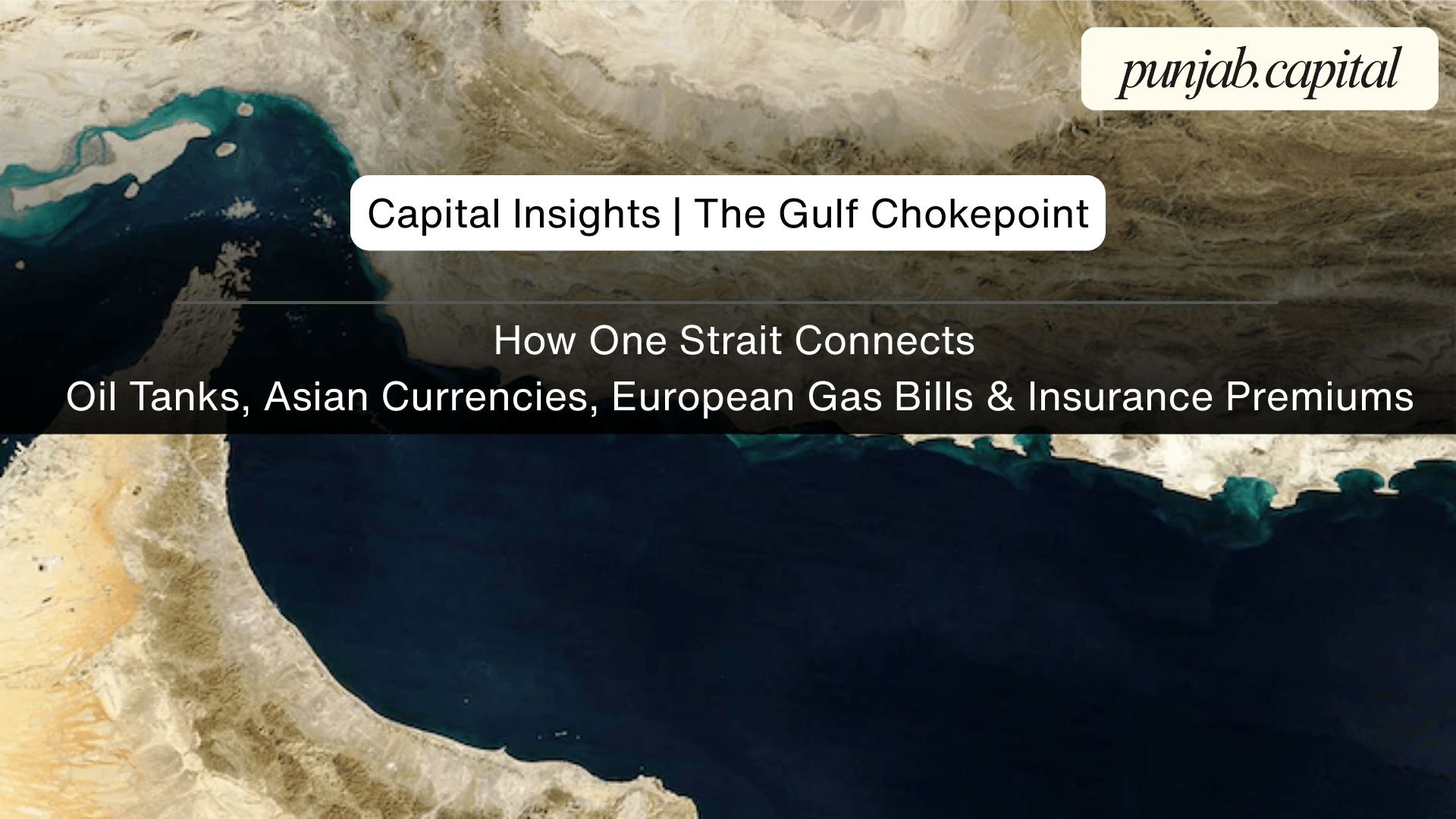
The Gulf Chokepoint | Systems view of Hormuz crisis & cascading global effects
How One Strait Connects - Oil Tanks, Asian Currencies, European Gas Bills & Insurance Premiums
A systems view of the Hormuz crisis and its cascading global effects
The effective closure of the Strait of Hormuz following US-Israeli strikes on Iran has triggered the most severe energy market disruption since the 1970s. But this is not simply an oil story. The crisis is cascading through interconnected systems: Asian currencies are diverging based on energy exposure, European gas reserves face a dangerous refill season, Gulf insurers are seeing five-fold premium increases, and corporate treasurers from Singapore to Doha are scrambling to hedge exposures they thought were theoretical. This analysis maps the transmission channels and feedback loops now reshaping global capital flows.
#StraitOfHormuz, #OilPrices, #EnergyMarkets, #AsianCurrencies, #GeopoliticalRisk, #GulfCrisis, #LNGMarkets, #CorporateTreasury, #FXHedging, #PoliticalViolenceInsurance, #EuropeanEnergy, #CapitalFlows
The Great Capital Repricing | Why 2026 Feels Different Sovereign Discipline for Private Capital
For the past 15 years, capital was essentially free. Central banks flooded the system with liquidity. You could borrow at near-zero rates. Risk was rewarded. Speculation was funded. Growth at any cost made sense. That era is over.
We're now in what we’re calling the Great Capital Repricing — where every asset, every business model, every portfolio is being re-evaluated against one simple question: 'What is this worth when money actually has a cost?' This isn't about bear markets or bull markets. This is about the structural recalibration of global capital. 2026 is not about speed. It's about structure. The zero-rate era rewarded velocity — how fast can you scale, how quickly can you flip. The repricing era rewards durability — how long can you compound, how resilient is your capital base.
#punjabcapital, #PunjabCapitalGlobalAllocationBrief, #TheGreatCapitalRepricing